Rebuild your filing history before you choose the next step.
Organize your filing years, account records, income documents, and correspondence into one factual packet. Record what you know, cite your evidence, and mark what still needs checking. Bring a clearer history to a qualified adviser.
Guide + fillable worksheets
Turn scattered records into one factual packet.
Keep documents, recollection, conflicting information, and unknowns visible. Finish with an indexed history and clear questions for your adviser.
Records guide (11 pages)
Preservation and chronology instructions, the evidence and confidence labels, worksheet guidance, two fictional examples, and dated sources.
Fillable worksheets (13 pages, 168 fields)
Filing-year inventory, chronology, income and account history, evidence and document index, official-correspondence index, missing-record tracker, year/account matrix, adviser handoff, and continuation notes.
Start here (read first)
How to open the worksheets, save a working copy, assign stable IDs, and assemble the handoff. Includes the scope statement and review status.
Preview the actual worksheets
Blank pages from the kit. Click a preview to see it at full size.
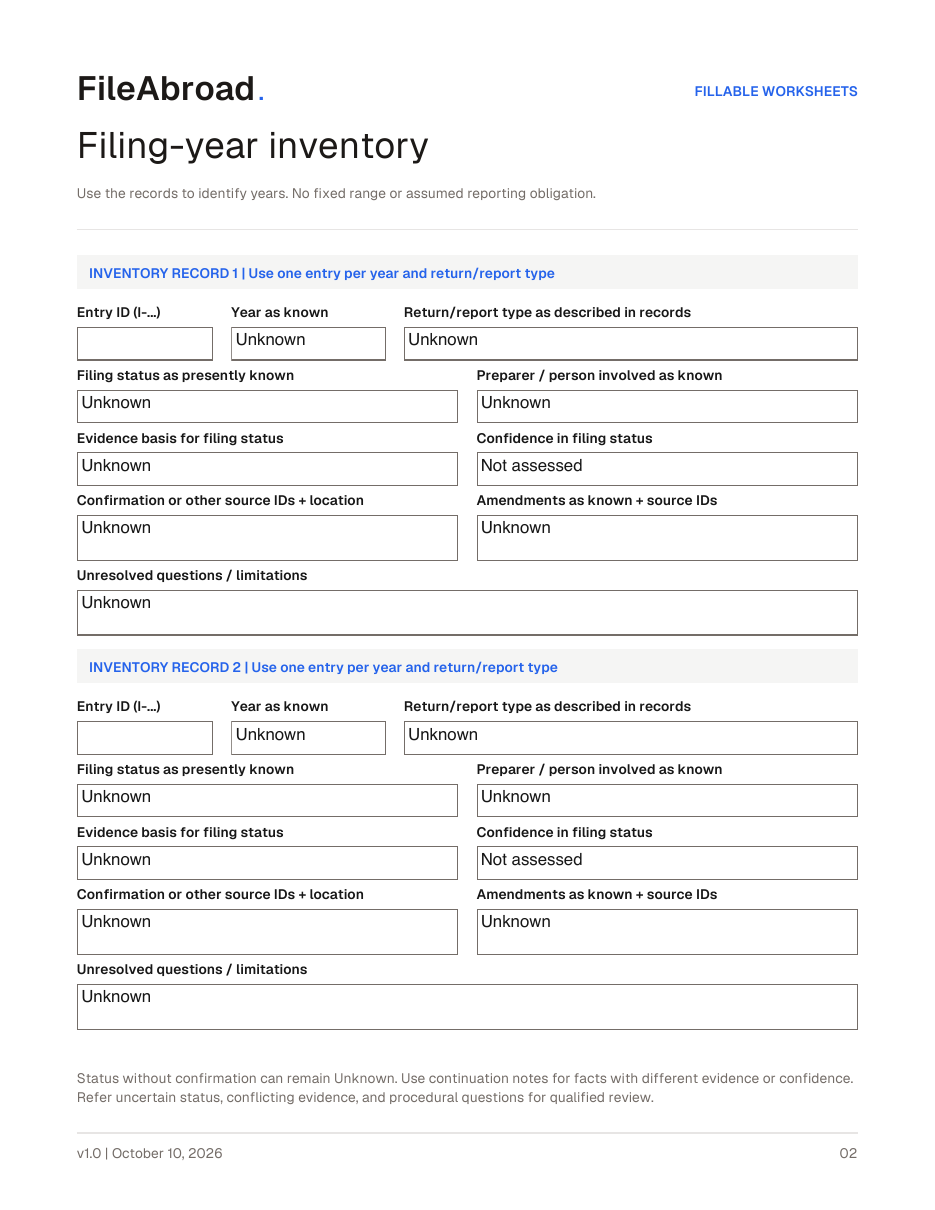
Filing-year inventory
Record the filing status as known. Unknown is a valid value.
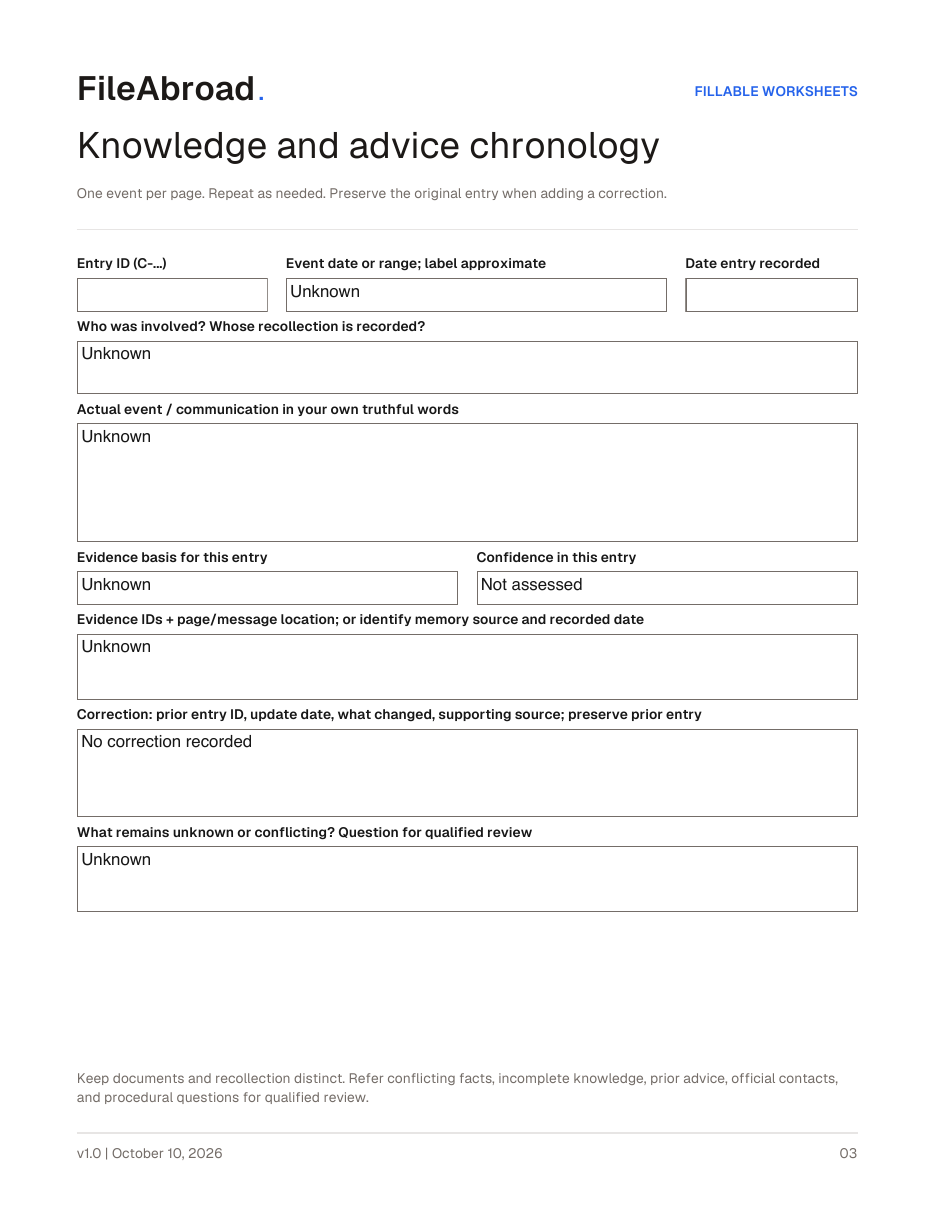
Factual chronology
Keep the source of an entry separate from your confidence in it.
What you will organize
- Start here. How to preserve records, work chronologically, and keep recollection separate from documented facts. Time-sensitive correspondence and uncertain legal questions are directed to qualified review.
- Filing-year inventory. Year, return or report type, filed status as presently known, preparer, confirmation evidence, amendments, and unresolved questions. "Unknown" is a valid field value.
- Income and asset history. Sources, employers, account institutions, ownership changes, available statements, and records requested — connected to years rather than an assumed lookback.
- Knowledge and advice chronology. Date, the actual event or communication, who was involved, what records support it, and whether the entry is memory or documented. Your own truthful words are kept.
- Official-correspondence index. Issuer, date, reference, topic, response records, and any stated dates needing adviser attention, copied exactly as shown. No automated procedural recommendation.
- Missing-record tracker. Record needed, institution or contact, request date, response, substitute evidence, and unresolved limitations. Absence of a record is never turned into "not filed."
- Adviser handoff. A factual chronology, a year/account matrix, indexed evidence, questions, and the boundaries of what has been reconstructed.
- Fictional examples. One memory-vs-email inconsistency and one unknown prior-year filing status. Both show correction and explicit uncertainty, not a polished declaration asserting an outcome.
One-time digital download. Includes the v1.0 guide, fillable worksheets, and start-here instructions. Download after payment and through a private email link for 30 days. Save a copy on your device. Personal tax advice, worksheet review, and filing are separate services.
The kit works with any number of years and imposes no filing lookback. It contains no procedure selector, declaration, or prewritten explanation. Do not delay time-sensitive help while completing it.
v1.0 · Official links checked 2026-10-10. This is a source-link check, not a claim of professional review.
The sequence
How to use the kit
Work in order. Each worksheet adds one part of the packet and keeps its own source references, so a reviewer can trace any entry back to a document or a recorded unknown.
- 1
Start with records, not conclusions
Preserve complete originals, work chronologically, and keep recollection separate from documented fact. Note the terminology to raise with a qualified adviser.
- 2
Build the filing-year inventory
Record the year, the return or report type as described in your records, the status as presently known, the preparer, confirmation evidence, amendments, and unresolved questions. "Unknown" is a valid value.
- 3
Record income and asset history
List sources, employers, account institutions, ownership changes, and available statements, and connect each to the relevant years rather than an assumed lookback.
- 4
Write the knowledge and advice chronology
One event per entry: the date or range, what happened, who was involved, the supporting records, and whether the entry is memory or documented. Keep your own truthful words.
- 5
Index official correspondence
Record the issuer, date, reference, topic, response records, and any stated response date exactly as shown. Flag dated correspondence for prompt review.
- 6
Track the missing records
Record the record needed, the institution or contact, the request date, the response, any substitute evidence, and the unresolved limitation. Absence of a record is not "not filed."
- 7
Index the evidence
Give each document one stable evidence ID and cite it in every linked entry. Note the page or passage and what the document does and does not establish.
- 8
Finish the adviser handoff
Assemble the chronology, the year/account matrix, the indexed evidence, your questions, and the boundaries of what has been reconstructed.
Referral prompts
Cases that go to a reviewer
The worksheets record these facts and route them to qualified review. The kit does not resolve them, and an entry being present does not make a treatment correct.
Official contacts and dated correspondence
Prompt qualified review
Stated response dates and time-sensitive correspondence are copied exactly and flagged. Do not delay time-sensitive help while completing the worksheets.
Conflicting facts
Review of conflicting evidence
Where two sources differ, both are preserved and the difference is described without choosing an explanation. Resolving it is a reviewer’s question.
Unknown filing status
Review of filing history
An invoice or organizer is evidence of that document, not proof a return was filed. Unknown status stays visible and is referred.
Prior advice
Review of prior advice and its meaning
The chronology records what the advice actually says. What it establishes is left to a reviewer.
Procedural choices
Qualified review before choosing a step
The kit records questions about which step to take. It does not select or recommend a procedure.
Incomplete knowledge or missing records
Records request or separate scope
A missing record stays a visible gap. The kit does not fill a gap by guessing or infer an earlier state of knowledge from a later event.
What the kit keeps true
Design checks the packet is built around
- Unknown facts remain visible and are never converted into a conclusion.
- Source (evidence basis) and confidence labels are distinct.
- No worksheet selects a procedure or produces a declaration.
- Dated correspondence and its stated dates are preserved.
- The handoff gives a reviewer enough context to ask informed questions.
Scope
What the kit does not do
This is a factual records-preparation kit, not a tax return, a procedure, or a tax opinion. It keeps your facts, sources, and open questions together so a qualified reviewer can work from them.
- It does not determine which returns or reports were required.
- It does not select or recommend a compliance procedure.
- It does not assess willfulness, conduct, or the significance of a fact.
- It does not predict penalties or promise an outcome or acceptance.
- It does not produce a declaration or a prewritten narrative asserting a legal outcome.
- It does not prepare, file, or amend any return or information report.
- It does not replace a verification agent or a licensed professional.
Preparation, individualized advice, and qualified review are separate from this download. Official contacts, time-sensitive correspondence, conflicting facts, incomplete knowledge, prior advice, and procedural choices each receive an explicit referral prompt rather than a conclusion. Do not delay time-sensitive help while completing the worksheets.
v1.0 · $29 USD one-time download. Missed U.S. Filings Reconstruction Kit is a downloadable records kit. No tax-preparation service, personalized advice, or qualified review is included.
Keep researching
This kit organizes factual records and open questions for a qualified adviser. It does not determine filing obligations, select a procedure, or prepare a return.
Free inquiry · Written scope
Get a Filing-Plan Scope
These tools are educational starting points. Submit broad facts for an agent to evaluate a supported written scope.